


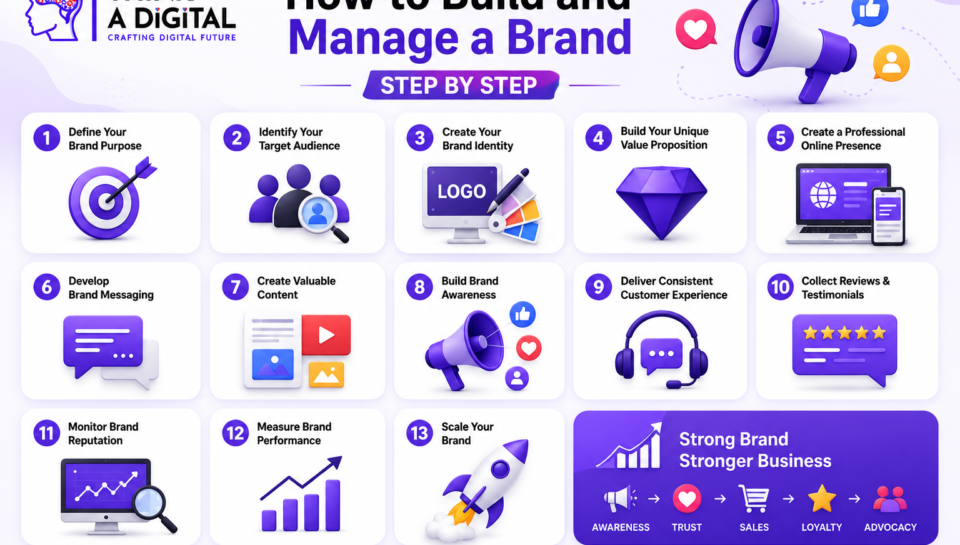
How to Build and Manage a Brand Step by Step
Building a brand is often misunderstood as a creative exercise. In reality, it’s a management process – one that requires clarity, consistency, and long-term thinking. Especially in a digital-first world, where customers interact with your brand across social media, search, websites, and conversations long before they ever contact you.
This is why brand building isn’t about occasional campaigns or visuals. It’s about how your business shows up repeatedly, and whether that presence builds trust or confusion over time.
This blog breaks down how to build and manage a brand step by step – from defining what your brand should represent to managing how it shows up daily across platforms, particularly on social media.
Before You Can Manage a Brand, You Need to Understand What a Brand Is
A brand is the perception people form about your business over time. It’s shaped by what you say, how you show up, and how consistently you behave. It’s not your logo or visuals. It’s the expectation people carry before interacting with you. Managing a brand means shaping that perception intentionally, instead of leaving it to chance.
How Brands Are Actually Built in the Digital World Today
Today, brands aren’t built through campaigns alone. They’re built through repeated interactions – posts, replies, content, tone, and visibility over time. Every touchpoint either strengthens or weakens perception. This is why modern brand building is less about creative bursts and more about consistent management across platforms.
With this context, the steps below become practical, not theoretical.
- Step 1: Decide What You Want People to Associate With Your Brand
Every strong brand starts with a clear internal decision.
Not a tagline.
Not a campaign idea.
A decision.
When someone comes across your business through content, social media, or conversation – what should immediately come to their mind?
- Reliability
- Expertise
- Simplicity
- Transparency
- Creativity
or
a very specific niche capability?
The mistake many businesses make is trying to project too many associations at once. When everything is emphasised, nothing sticks. On social media, this shows up as scattered content – one post about sales, another about motivation, another about trends – all without a central narrative.
Brand building begins when you choose one primary association and commit to reinforcing it consistently.
Step 2: Turn That Association Into Consistent Communication
Once you know what you want to be known for, the next challenge is communication.
This is where brand voice comes in – not as a stylistic choice, but as a behavioural one. How you explain things, how you respond to comments, and how you position your services all shape how the brand is perceived.
If your website sounds formal, your Instagram sounds casual, and your LinkedIn sounds corporate, the brand feels fragmented. People may like individual posts, but they won’t recognise the brand as a whole.
Consistency doesn’t mean repeating the same words. It means repeating the same intent and tone across formats. This is where structured social media management plays a critical role.
Step 3: Build Trust by Showing How You Work, Not Just What You Offer
Trust is the currency of branding, and trust is built through proof.
Audiences today don’t believe claims unless they see how those claims are backed up. This doesn’t require polished case studies or big achievements. It requires visibility — showing your process, your thinking, your approach, and even your limitations.
On social media, this might look like behind-the-scenes work, explanations of decisions, real interactions, or lessons from experience. These signals quietly build credibility without forcing a sale.
Step 4: Use Social Media to Reinforce the Same Brand Narrative Repeatedly
Social media is where brand management either compounds or collapses.
Many brands chase trends or viral formats without asking whether those ideas reinforce the brand’s core narrative. Over time, this creates noise instead of recognition.
Strong brands treat social media as a reinforcement tool. The same ideas are expressed in different ways, across different formats, over long periods of time. This repetition is intentional. People don’t remember what they see once. They remember what they see consistently.
Step 5: Manage the Brand Daily, Not Occasionally
Brand building doesn’t fail because of one wrong post. It fails because no one is actively managing it.
Daily brand management involves paying attention to how the brand is perceived, ensuring replies align with tone, keeping messaging consistent, and making sure new content fits the existing narrative. This work isn’t glamorous, but it’s where brands are protected.
When brand management becomes a continuous responsibility rather than a campaign task, consistency emerges naturally.
Step 6: Let the Brand Evolve Without Losing Its Core
As businesses grow, brands need to evolve. New services are added. New audiences emerge. New platforms become relevant.
The risk lies in changing too much, too quickly.
Strong brands adapt carefully. They expand without contradicting what they’ve already built. New content and communication still align with the original association chosen in the beginning. This balance allows brands to scale without losing identity.
The Reality of Long-Term Brand Building
Brand building is slow by design. Attention can be bought. Trust has to be earned.
Brands that last are not the loudest or trendiest. They are the clearest. They show up regularly, communicate honestly, and reinforce the same message until it becomes familiar. Over time, that familiarity compounds.
Where This Leaves You
Managing and building a brand isn’t about doing more content or chasing growth aggressively. It’s about clarity, consistency, and deliberate presence – especially on social media, where perception is shaped daily.
When brand definition, communication, proof, and presence work together, social media stops being a task and becomes a long-term asset.
At Think A Digital, this is how we approach Social Media Management – as structured brand management designed to build recognition and trust over time.
And that’s the right place to pause. With clarity.
1. What does it actually mean to build a brand?
Building a brand means shaping how people perceive your business over time. It’s not about visuals alone. It’s about consistency in communication, behaviour, and presence across platforms. A brand is built through repeated interactions, not one-time campaigns.
2. Is brand building only about social media?
No. Social media plays a major role today, but brand building also includes your website, content, tone of communication, customer experience, and how consistently your message shows up everywhere. Social media simply makes these signals more visible.
3. How long does it take to build a strong brand?
Brand building is a long-term process. While visibility can increase quickly, trust takes time. Most strong brands are built through months and years of consistent presence, clear messaging, and deliberate communication – not shortcuts.
4. Why is consistency so important in brand management?
Consistency helps people recognise and remember your brand. When messaging, tone, or positioning changes frequently, trust weakens. Consistent communication reduces confusion and strengthens familiarity, which is essential for long-term brand growth.
5. Can small businesses build strong brands without big budgets?
Yes. Strong brands are built on clarity and consistency, not budget. Small businesses often have an advantage because they can communicate more personally, show real processes, and stay focused on a clear narrative without corporate noise.
6. How does social media management support brand building?
Social media management ensures your brand narrative is reinforced regularly instead of being diluted by random posts or trends. It helps maintain tone, consistency, and relevance – turning social platforms into long-term brand assets rather than short-term posting tasks.