

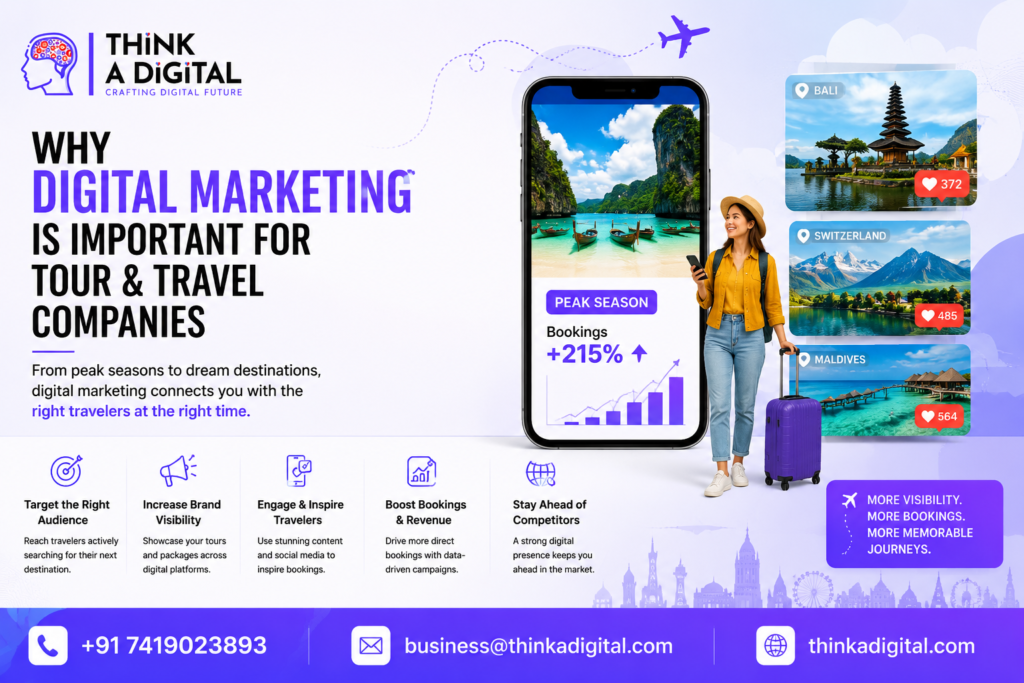
Why Digital Marketing Is Important For Tour And Travel Companies
In this digital era, where social media has turned the world into one big visual diary – almost everyone is online, scrolling, saving, dreaming. And travel, more than anything else, is being shaped by this constant stream of content. One beautiful clip, one story, one reel is enough to plant a seed.
And that’s exactly why digital marketing is like a nuke for tour and travel companies. Because nobody just wakes up one morning and decides “Bas, today I’ll go to Europe,”. Or maybe some do – however, that impulsive decision isn’t actually impulsive. Somewhere – consciously or unconsciously, they must have consumed something online that nudged them, inspired them, or whispered, “I should definitely go there.
- And it could be anything from,
- A Maldives reel.
- A Ladakh travel vlog.
- A blog about Europe in budget.
- Or
- A Pinterest board filled with blue skies and snow-capped peaks.
There is absolutely no limit to what can trigger that first thought.
What Happens Next? How Modern Travellers Make Decisions
One thing is very clear, before someone ever calls a tour and travel company, they have already done their research. They have watched hundreds of reels, read blogs, checked online reviews, and looked at 30+ photos of that destination.
Today’s traveller isn’t walking into a physical office. They are walking into Google, Instagram, YouTube, and TripAdvisor. Their behaviour is predictable, logical, and surprisingly emotional but it is also quite easy to decode:
- 1. Inspiration: They see a reel, a vlog, a couple sharing their honeymoon clips, a stranger backpacking through Bali.
- 2. Research: They search “best places to visit,” “budget trips,” “best time to visit XYZ,” “tour packages.”
- 3. Trust Check: They stalk reviews, testimonials, Google ratings, Reddit discussions, Pinterest boards, and Instagram highlights.
- 4. Price & Comparison: They jump between MakeMyTrip, Agoda, and local agencies online.
- 5. Book or Save for Later: Most bookings come from people who researched days – or even weeks – before.
And with the help of digital marketing you can align your business with this existing behaviour. Because no matter how great your packages are, if a traveller cannot find you online during these 5 stages. They will choose someone else instantly.
Why Is Digital Marketing The Backbone Of The Travel Industry?
All of us know that travel is a very saturated market. There are thousands of companies selling the same destinations, same itineraries, same hotels at the same packages. So differentiating can sometimes be difficult.
But that is until you create a strong digital presence backed by brands’ trust, and high content quality. Because it makes a traveller feel like they know you. And that’ s why not utilising a digital marketing agency for tour and travel companies is non-negotiable, because
1. It puts you exactly where travellers are searching
Modern travellers live on Google, Instagram, YouTube, Pinterest, travel blogs, and trip-planning apps. If your travel company isn’t active on these platforms, you don’t just lose visibility – you lose existence.
2. It builds trust through real experiences.
Digital marketing allows you to showcase customer reviews, UGC, video testimonials, reels from group tours, and itinerary walkthroughs. In travel, trust is everything – and online content builds trust faster than brochures.
3. It converts travel desires into enquiries.
Reels, blogs, ads, landing pages, CTAs, and retargeting transform curiosity into bookings. Without digital touchpoints, interest dies before it reaches you.
4. It helps you stand out against competitors.
You may not beat OTAs like MakeMyTrip on price, but you can beat them in personalization, authenticity, and storytelling – all through digital.
5. It keeps your travel business running 24/7.
Your office closes, but your website, ads, social media, blogs, and Google Business Profile keep working, attracting leads round the clock.
So going digital means your business will keep running even when you’re not.
Key Digital Marketing Channels And How To Use Them
Digital marketing isn’t just about showing up everywhere. It’s about showing up where it matters. And for travel companies, these are the five channels that actually move the needle. Let’s break each one down and understand not just what they are, but how to use them effectively.
- SEO for Travel Companies (Your Most Powerful Long-Term Asset)
SEO is the most safest tool if you want to bring consistent, high-intent organic traffic on your website. It helps google to recommend you to those people who are searching for trips, budgets, and itineraries. However, one thing to consider is that SEO takes time. But when done right, it becomes a long-term engine that brings bookings month after month.
- Social Media Marketing (Where Dreams Turn Into Desire)
Travel is a visual category – and social media is where dream-building happens. It feeds on our emotions and when we see someone enjoying their trips, we subconsciously picture ourselves there. This visual imagination pushes us closer to booking to take that picture.
And now we have so many platforms like
- Instagram: Where we share reels, stories, highlights
- YouTube: with vlogs, itinerary breakdowns
- Pinterest: with ideas, mood boards
- TikTok (globally): Short-form travel snippets
- Facebook: Groups, families, and older audience
that this visibility has transitioned into desires.
- Paid Ads (The Fastest Way to Generate Travel Enquiries)
One of the fastest and efficient methods to reach travelers who are ready to book now.
Unlike organic content, paid ads allow you to appear in front of people with high purchase intent at the exact moment they’re searching, scrolling, or comparing travel options.
And the best part?
Paid ads can boost your conversions by 200-300%, because you’re following people who already showed interest.
Paid ads = immediate visibility + fast enquiries + predictable results.
The best platforms to utilise this methods:
- Meta Ads (Instagram + Facebook)
Best for inspiring travellers through visuals like reels, graphics, story ads, carousel itineraries, and limited-time promotions.
- Google Ads
Google Ads bring faster conversions, high-quality enquiries, with stronger lead intent. It most likely targets people who are much closer to booking.
- Content Marketing (Your 24/7 Relationship Builder)
Not every traveller books instantly. Most of them browse today, compare tomorrow, think for a week, and then come back when the timing (or budget) finally feels right. And for that you need something that keeps your brand alive for a longer period of time. That is why content marketing fits perfectly right here because it builds authority + trust + familiarity.
When done right, your content becomes the silent salesperson that works 24/7 – educating travellers, answering their questions, calming their doubts, and guiding them back to you when they’re finally ready to book.
Best type of content that works for all travel companies:
YouTube explainers
- Blogs
- Email sequences
- WhatsApp broadcasts
- Destination guides
- Lead magnets (like “Free Travel Checklist”)
- Ebook itineraries
- Comparison guides
Email & WhatsApp Marketing (Your Highest-ROI Channels)
Most travellers don’t book on the first interaction. They enquire, compare prices, check reviews, think, and then decide later. That gap between “interest” and “decision” is where most travel companies lose potential customers – unless they know how to stay present. This is the exact sweet spot where Email and WhatsApp marketing deliver the highest ROI.
Both channels let you nurture warm leads with gentle, timely reminders. And that consistency often turns an unsure lead into a confirmed booking.
These channels convert warm leads into confirmed bookings.
What Digital Marketing Actually Brings To A Travel Business
Digital marketing isn’t just about getting likes or posting pretty pictures. It’s about driving actual business growth. For travel companies, the impact is even deeper because travellers rely heavily on online impressions before making a decision. When done right, digital marketing brings clarity, trust, and consistent enquiries.
- More Qualified Leads
Digital filters out time-wasters. It attracts high-quality, informed leads – travellers who already know what they want because they’ve researched online. That makes your conversations easier, faster, and more conversion-ready.
- Higher ROI
It offers measurable, predictable results. You know exactly which ad, reel, blog, or email brought the lead in – and you can scale what works.
- Automated Lead Generation
Third, it builds long-term brand trust, which is priceless in a saturated travel market. A strong digital presence can make your company look more credible, experienced, and traveller-friendly.
- Visibility = Trust = Bookings
Most importantly, digital marketing keeps your business visible 24/7 – even when your office is closed.
- The more people see you,
- the more they trust you,
- the more they buy from you.
- Simple psychology.
How to Build a Winning Digital Marketing Strategy for Travel (Step-by-Step)
A strong digital presence isn’t built by chance – it’s built by strategy. And for a travel business, your strategy needs to align with how travellers behave online. The goal isn’t just to “be everywhere,” but to be present at the moments that influence decisions.
- Step 1: Know Your Traveller Personas
Honeymooners, families, solo travellers, luxury seekers, adventure lovers – each audience type needs different content, messaging, and offers.
- Step 2: Build a Strong Website
Your website is your digital office. It should load fast, clearly show packages, highlight reviews, and make enquiries effortless.
- Step 3: Create High-Intent Content
Destination guides, best-time-to-visit blogs, budget breakdowns, local tips – content that helps travellers plan instantly builds trust.
- Step 4: Use Social Media Consistently
Post 4-6 times a week. Reels, stories, reviews, itineraries – consistency builds brand recall and keeps you visible.
- Step 5: Use Paid Ads Smartly
Run Google Search Ads for high-intent keywords and retarget warm leads through Meta Ads.
- Step 6: Build Automation
WhatsApp sequences, email drip campaigns, and saved responses help convert hesitant leads over time.
Common Digital Marketing Mistakes Travel Companies Make
Even though the travel industry is thriving online, many agencies still hold themselves back without realising it. And most of the time, it’s not the lack of budget or talent – it’s a few avoidable mistakes that cost them visibility, trust, and bookings.
- Posting Randomly
Inconsistency confuses the audience. Travellers trust brands that show up regularly.
How to fix it: Create a content calendar.
- Ignoring SEO Completely
Most travel companies rely only on social media, forgetting that Google is the first place travellers search for packages, itineraries, and costs.
How to fix it: Write blogs + optimise pages.
- Using Only Generic Stock Photos
Real photos and UGC build far more trust than polished stock images.
How to fix it: Use real customer content.
- No Retargeting Ads
Most travellers don’t book instantly. Without retargeting, you lose warm leads who just needed one more nudge.
How to fix it: Add Facebook Pixel & run retargeting.
- Poor Website Experience
Slow pages, outdated designs, or no clear CTAs make travellers lose confidence instantly.
How to fix it: Improve speed, update design, add clear CTAs, and make enquiries effortless.
- No Follow-Up System
Many good leads go cold simply because no one followed up via WhatsApp or Email.
How to fix it: Use 3 Step Email and WhatsApp automations.
The Future Of Digital Marketing In Travel Industry
The travel industry isn’t just evolving. It’s transforming at a pace we’ve never seen before. Traveller expectations are changing, technology is changing, and the way people plan trips is becoming more personalised than ever. This means the future of travel marketing will be shaped by brands that understand one thing clearly: travellers want convenience, confidence, and connection.
And travel companies that adopt these digital marketing tools early will not just stay relevant – they will dominate.
Final Thoughts: Digital Presence Is Your New Travel Office
In a world where the travel industry is overflowing with options, travellers don’t choose the cheapest company. They choose the most visible, most trustworthy, and most consistent one. That’s the power of digital. If your travel brand shows up online with clarity, confidence, and credibility, you’ve already won half the battle.
And the remaining half?
It’s simply about staying present – consistently, creatively, and intentionally.
Why is digital marketing important for travel companies?
Because travellers plan their entire trip online – from inspiration to comparison to booking. If your brand isn’t present digitally, you lose visibility, trust, and enquiries to competitors who are showing up consistently.
Which digital marketing channels work best for travel businesses?
There is no one specified channel. Go for all like SEO, Social Media Marketing, Google Ads, Instagram Ads, Content Marketing, and WhatsApp/Email follow-ups. These channels help you attract, nurture, and convert travellers at different stages of their journey.
How long does it take for digital marketing to show results?
Paid ads can show results quickly (days/weeks). Whereas SEO, content, and social presence may take time (2-3 months) but they deliver long-term, compounding growth.
How do travel agencies get more enquiries online?
Simply combine: High-quality content + Strong social presence + Retargeting ads + Clear CTAs + Fast website + WhatsApp/Email follow-ups. This system keeps enquiries flowing consistently.
What type of content works best for travel marketing?
Reels, UGC, destination guides, itinerary breakdowns, blogs, reviews, behind-the-scenes clips, drone shots, and comparison content (“Bali vs Thailand”) – anything that gives value and builds confidence.
Is digital marketing expensive for small travel companies?
Not necessarily. You can start small with organic content, basic ads, and WhatsApp marketing. The key is consistency – not huge budgets.